
How Can You Grow a Business Online?
You can grow a business online by understanding your target customers, building a trustworthy online presence, attracting relevant visitors through SEO and social media, converting enquiries into customers, and measuring what actually produces results. The right strategy depends on your business model, audience, location, budget, and goals.
Before choosing a platform, decide what you want to improve: **website traffic, leads, store visits, online sales, or repeat purchases.** This keeps your digital marketing focused on business outcomes rather than vanity metrics.
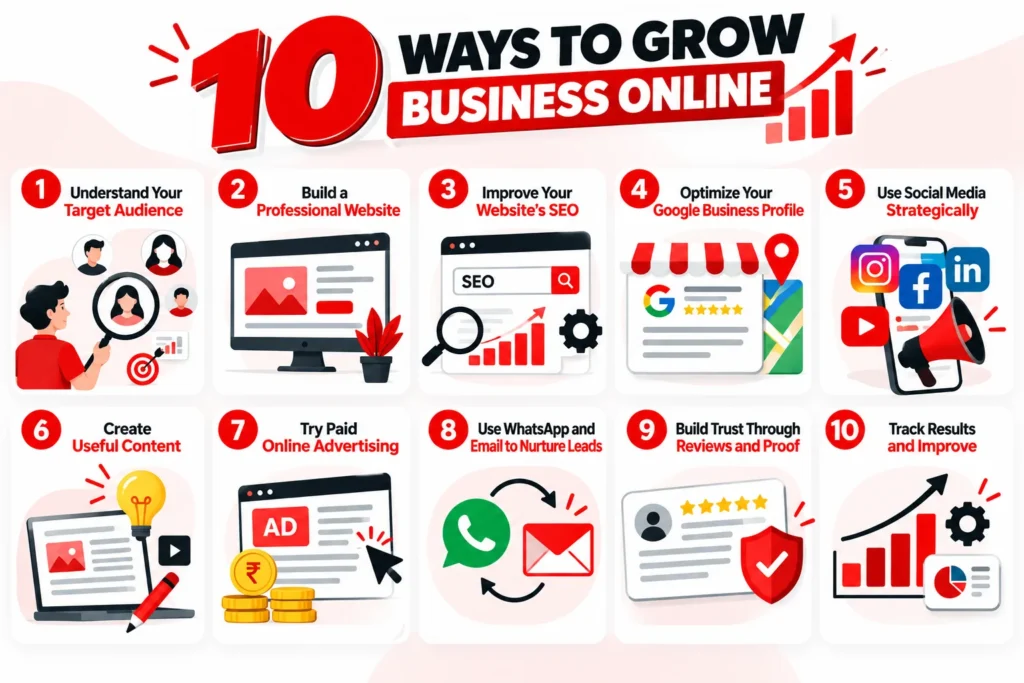
10 Ways to Grow a Business Online
1. Understand Your Target Audience
Effective online marketing starts with knowing who you want to reach.
Define your ideal customer by location, age group, needs, buying behaviour, budget, and the problems your product or service solves. Also consider where they search for information.
For example, a Jaipur clothing shop may focus on customers searching for ethnic wear nearby, while a B2B consultant may need educational content and professional networking.
**Action:** Create one simple customer profile before choosing your marketing channels.
2. Build a Professional Website
website sYourhould make it easy for visitors to understand what you offer and take the next step.
Include:
– Clear product or service pages
– Mobile-friendly design
– Contact details
– Strong calls to action
– Pricing or quotation information where appropriate
– Customer reviews or testimonials
– Frequently asked questions
– Clear delivery, return, or service policies
For an online seller, platforms such as Shopify or WooCommerce can support an e-commerce setup. Indian businesses should also make checkout and digital payment options convenient.
Your website does not need to be complicated. It needs to be **clear, fast, trustworthy, and useful**.
3. Improve Your Website’s SEO
Search engine optimization helps potential customers discover your website through Google Search.
Start with basic SEO:
1. Research the terms your customers actually search for.
2. Create useful pages around those topics.
3. Write descriptive page titles and headings.
4. Add relevant internal links.
5. Make pages easy to use on mobile devices.
6. Monitor performance through Google Search Console.
Google recommends creating helpful, reliable, people-first content rather than content written primarily to manipulate search rankings.
For example, instead of creating a generic page titled “Best Services,” a home-cleaning company could create a useful service page answering what is included, which areas it serves, how customers can book, and what questions customers commonly ask.
4. Optimize Your Google Business Profile
For eligible local businesses, Google Business Profile can help customers discover the business on Google Search and Maps.
Keep your business name, address, phone number, opening hours, categories, photos, and other important information accurate and up to date. Respond to genuine customer reviews and regularly add useful business information.
Google states that local results are primarily influenced by **relevance, distance, and prominence**. Complete and accurate business information can help Google understand how a business matches relevant local searches.
This is particularly useful for restaurants, salons, retailers, clinics, service businesses, and other businesses serving a defined area.
5. Use Social Media Strategically
You do not need to be active on every social platform.
Choose channels based on where your customers spend time and what type of content suits your business. Instagram may work well for visual products, while YouTube can support demonstrations, tutorials, and educational content.
Try content such as:
– Product demonstrations
– Before-and-after examples
– Frequently asked questions
– Customer stories
– Educational tips
– Behind-the-scenes content
– Offers and new arrivals
The goal is not simply to collect followers. Aim to turn attention into **website visits, enquiries, store visits, or sales**.
6. Create Useful Content
Content marketing gives potential customers a reason to discover and trust your business.
Useful formats include blogs, short videos, FAQs, buying guides, tutorials, comparison pages, and educational social posts.
Think about the questions customers ask before buying.
An Indian handicraft seller, for example, could publish content explaining how products are made, how to choose the right size, how to care for them, and what makes the materials different.
Google’s guidance emphasizes original, useful information that provides value beyond simply summarizing what already exists online.
7. Try Paid Online Advertising
Paid advertising can help a business test demand and reach targeted audiences without waiting for organic traffic to develop.
Possible channels include **Google Ads** and **Meta Ads**.
Start with one clear objective, such as:
– Generate enquiries
– Drive online purchases
– Get phone calls
– Promote a specific product
– Bring visitors to a landing page
Set a defined budget and measure conversions before increasing spending. Google Ads supports conversion measurement for actions such as purchases, sign-ups, and calls.
Avoid spending money simply to generate clicks. A campaign should have a clear connection between the advertisement, landing page, enquiry, and business goal.
8. Use WhatsApp and Email to Nurture Leads
Not every visitor buys immediately.
Permission-based WhatsApp or email communication can help businesses follow up with interested customers, answer questions, share useful updates, and encourage repeat purchases.
For example, an online store can send a customer order updates, relevant product information, or future offers where appropriate.
Keep communication useful and respectful. Sending too many promotional messages can damage customer trust.
9. Build Trust Through Reviews and Proof
People want confidence before spending money with an unfamiliar business.
Use genuine customer reviews, real product images, clear pricing, transparent policies, testimonials, and prompt responses to common questions.
Never buy or fabricate reviews.
For local businesses, reviews can also contribute to local visibility. Google notes that review information is among the signals it uses when assessing prominence in local search.
Trust should appear throughout the customer journey—not just on the homepage.
10. Track Results and Improve
The most important part of online business growth is understanding what produces business results.
Track metrics such as:
– Qualified leads
– Conversion rate
– Sales
– Cost per lead
– Customer acquisition cost
– Repeat purchases
– Relevant organic traffic
Google Analytics can collect website and app data for reporting and analysis, while Google Ads provides conversion measurement for actions that matter to the business.
Do not change everything at once. Identify what is working, improve weak points, and then test the next change
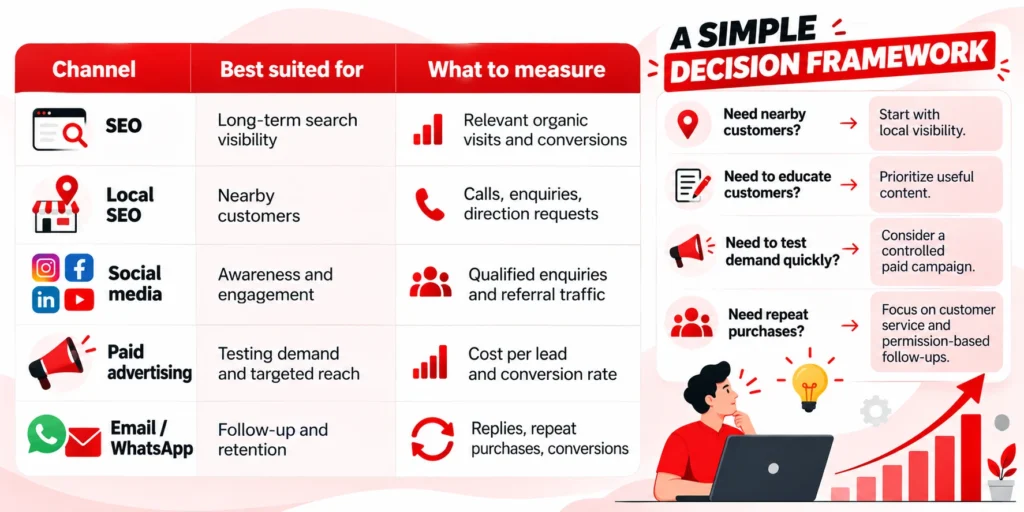
Which Online Marketing Channel Is Right for Your Business?
Channel | Best suited for | What to measure |
|—|—|—|
| SEO | Long-term search visibility | Relevant organic visits and conversions |
| Local SEO | Nearby customers | Calls, enquiries, direction requests |
| Social media | Awareness and engagement | Qualified enquiries and referral traffic |
| Paid advertising | Testing demand and targeted reach | Cost per lead and conversion rate |
| Email / WhatsApp | Follow-up and retention | Replies, repeat purchases, conversions |
A simple decision framework can help: **need nearby customers? Start with local visibility. Need to educate customers? Prioritize useful content. Need to test demand quickly? Consider a controlled paid campaign. Need repeat purchases? Focus on customer service and permission-based follow-ups.**
## How Much Does It Cost to Grow a Business Online?
There is no single cost for digital marketing for small businesses. Your budget depends on your industry, competition, location, goals, tools, and whether you handle the work yourself or hire professionals.
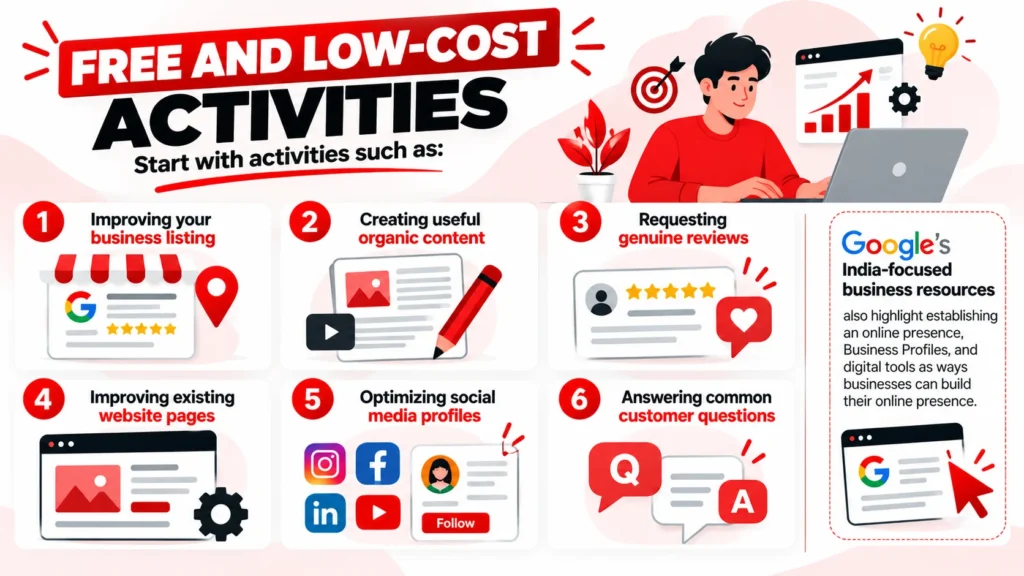
### Free and Low-Cost Activities
Start with activities such as:
– Improving your business listing
– Creating useful organic content
– Requesting genuine reviews
– Improving existing website pages
– Optimizing social media profiles
– Answering common customer questions
Google’s India-focused business resources also highlight establishing an online presence, Business Profiles, and digital tools as ways businesses can build their online presence.
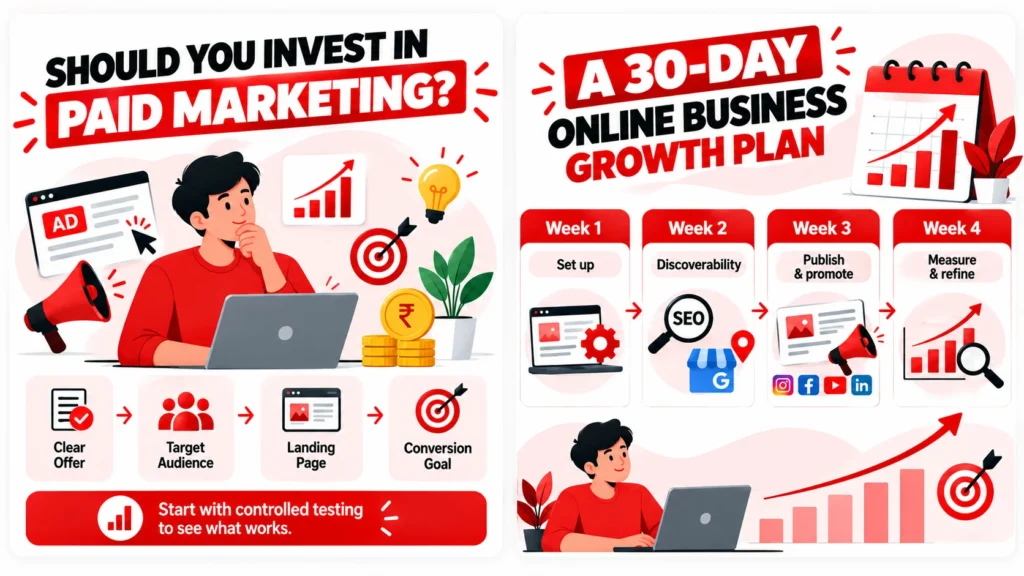
When Should You Invest in Paid Marketing?
Consider paid advertising after you have a clear offer, target audience, landing page, and conversion goal.
Start with controlled testing rather than committing a large budget immediately. If you cannot tell which campaign produced a lead or sale, improve your tracking before increasing spend.
## A 30-Day Online Business Growth Plan
| Week | Main focus | Actions |
|—|—|—|
| Week 1 | Set up | Define customer, offer, goal, website and online profiles |
| Week 2 | Discoverability | Improve SEO, Google Business Profile and social profiles |
| Week 3 | Publish & promote | Create useful content and test one relevant promotional channel |
| Week 4 | Measure & refine | Review traffic, enquiries, sales and conversions |
The aim is not to complete every marketing activity in 30 days. The goal is to establish a system you can continue improving.
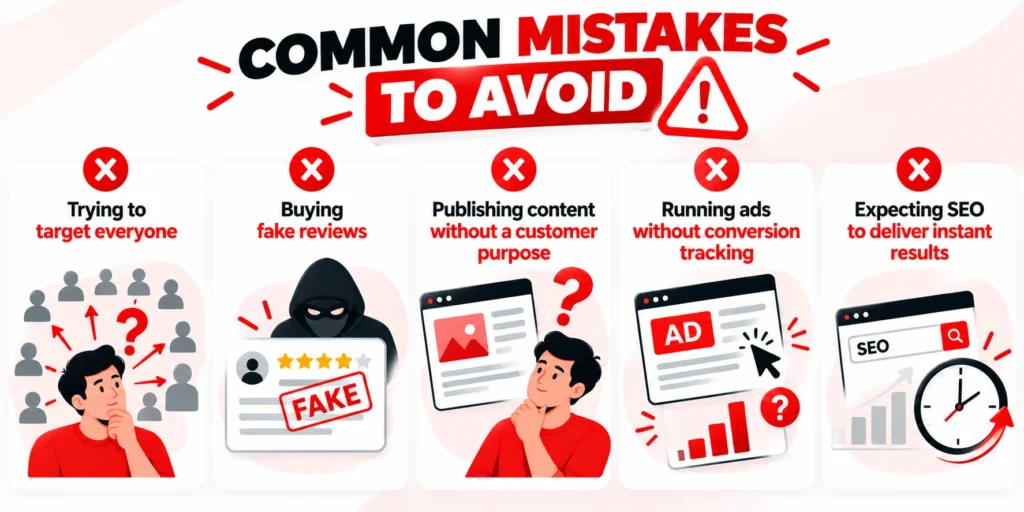
Common Mistakes to Avoid
Avoid trying to target everyone, buying fake reviews, publishing content without a customer purpose, running ads without conversion tracking, and expecting SEO to deliver instant results.
Online growth is usually the result of **consistent execution and improvement**, not one viral post or one optimization trick.
## Frequently Asked Questions
How can I grow my business online?
LIdentify your target customers, create a professional online presence, improve search visibility, publish useful content, promote your offer through relevant channels, and track leads and sales.
How can I promote my small business online for free?
Use eligible business listings, organic social media content, SEO, genuine customer reviews, useful content, and customer referrals.
How can I get customers for my business online?
Make your business easy to discover, explain your offer clearly, build trust, provide an easy enquiry or purchase process, and measure which channels generate qualified customers.
Which online platform is best for small businesses?
There is no universal best platform. Local businesses may prioritize Google Search and Maps, visual businesses may use social media, and B2B companies may benefit from professional networks and educational content.
5. How can I grow my business online in India?
Start with a website or suitable online presence, Google Business Profile for eligible local businesses, relevant social media, SEO, convenient communication, digital payments, and measurable marketing activities.